
Recipe Management, Costing and Inventory: Three Pillars of Hospitality Success
Recipe management, costing and inventory are the three pillars of hospitality success. Full guide with practical examples for restaurants.
Packed house but still in the red? Many hospitality operators know this dilemma: the restaurant is busy, guests are happy, yet barely any profit is left at the end of the month. Why? Often, fundamental business practices are neglected – standardised recipes, correct pricing and thorough inventory. Passion and creativity alone do not pay the bills; without a watchful eye on costs and processes, even a well-frequented business can slip into the loss zone. In this article we examine why recipe management, pricing and inventory together hold the key to solid margins, and how they work hand in hand in practice to prevent losses.

Below we show, in a strategic yet practical way, how recipe accuracy, optimised cost-of-goods calculation and regular stock checks interact. We draw connections between recipe compliance, cost of goods, contribution margins and stock variances, and address common mistakes. The goal: clear action points so that your hospitality offering succeeds not only culinarily but also economically.
Recipe Management: Precision on the Plate Secures Your Costing
Profitability is already decided in the kitchen. Recipe management means defining exact recipes with specified ingredient quantities and portion sizes for every dish – and consistently sticking to them. This recipe compliance is not bureaucratic box-ticking; it is the foundation for reliable costings. Only when all chefs follow prescribed quantities do you know the cost of goods per portion exactly. If recipes are “freely interpreted” and everyone cooks their own version, it becomes virtually impossible to produce reliable figures on costs and consumption.
Why does this matter so much? Every deviation from the recipe – be it an oversized portion, an extra ingredient or inefficient preparation – pushes costs up. Fluctuating portion sizes between different team members lead to uncontrolled consumption and ultimately higher cost of goods. If, for example, 220 g of meat ends up on the plate instead of the planned 200 g, or the bartender pours generously, the cost per unit sold rises – often unnoticed. The consequence: the calculated contribution margin (selling price minus variable costs) shrinks because cost of goods turns out higher than planned. In the stockroom, such over-portioning shows up as unexplained shortages – known as stock variances, frequently caused by poor recipe compliance.
Best practice in the kitchen: rely on clear recipes and portioning aids. Document in writing which ingredients go into each dish and in what quantity. Modern recipe management software, such as BarBrain’s, or at least a well-maintained recipe book helps you keep track and quickly adjust all costings when ingredient prices change. Train your kitchen team on uniform portion sizes – use scales, measuring jugs, ladles with a defined volume, etc. to measure quantities precisely. This ensures that a schnitzel is the same size today and tomorrow and that a cocktail always contains the same measure of spirit. Standardised ml specifications per glass, for example, deliver consistent taste and less shrinkage at the bar. Through this discipline you know the true cost of every plate and can build your pricing on that foundation. At the same time, quality benefits: guests always receive the product they expect, and you avoid the risk that generous portions generate enthusiasm but ruin your costing.
Typical traps in practice: seemingly minor items are often left out of the calculation – the dip with the burger, the bread served upfront, or garnishes and seasonings. These “invisible” cost-of-goods items add up. Make sure to account for waste and preparation losses: trimming vegetables or butchering meat produces offcuts that reduce the usable yield. Precise recipe management factors in these losses – for instance by setting a higher raw-material requirement or applying a calculation surcharge. If such costs are overlooked, money is missing from the till at the end of the day.
In summary, rigorous recipe management secures your costing foundation: you know what a dish actually costs in terms of goods, and you create the basis for charging prices that cover your costs and generate profit. Recipe compliance also reduces food consumption and waste – a plus for both margins and sustainability.
Pricing: Calculating Cost of Goods and Setting Optimal Prices
Setting prices in hospitality “by gut feeling” or blindly copying competitors is dangerous. Sound price calculation, on the other hand, is decisive for commercial success. In fact, many operators struggle with profitability precisely because prices are incorrectly calculated. The classic rule of thumb “cost of goods times three = selling price” often falls short today. Why? Because it factors in neither overheads, labour costs, taxes nor fluctuations in commodity prices. Anyone who simply triples the ingredient purchase cost easily overlooks factors such as energy consumption for preparation, the chef’s time, or hidden costs for oil, spices or side dishes. The consequences can be devastating: prices set too low lead to certain dishes being sold at a loss without anyone noticing, while prices set too high drive guests away. And fluctuating purchase prices (e.g. seasonal spikes) erode your margin if not adjusted for.
The right approach: the starting point for every pricing exercise is to calculate the cost of goods precisely. For this, every ingredient in a recipe must be captured down to the last gram and priced – including marinades, garnishes and even the smallest items. Use the results of your recipe management: if you know that a dish costs, say, €4.50 in pure food costs, you can determine an appropriate selling price on that basis. Typically, surcharges for overheads, labour and profit margin are then added. A practical example formula:
Food cost + approx. 40 % surcharge for ancillary goods costs (storage, waste) + 30 % overheads + calculated profit margin = base price
plus approx. 17–20 % labour costs = net selling price
plus VAT = gross final price
Such a detailed calculation ensures all costs are covered. In practice, simpler methods have also often delivered good accuracy: many hospitality businesses work with mark-up factors per category. For main courses a factor of around 3.0–3.5 is common, for starters and desserts somewhat higher (3.5–4.0), and for drinks significantly higher – e.g. ~4.0 for wine and up to ~8.0 for soft drinks. These ranges reflect the fact that beverages generally tolerate a higher raw mark-up than food (drinks typically carry higher margins than food). The key is to find the right factor for your own concept: a simple country inn cannot charge the same prices as a fine-dining restaurant in the city centre – where higher mark-ups are acceptable due to a higher cost structure and perceived value.
Regardless of which calculation method you use, check your cost-of-goods ratio regularly – i.e. the ratio of cost of goods to revenue. It shows whether your prices are still on track. As a rough benchmark, many restaurants aim for 25–30 % cost of goods; anything significantly above that erodes profit considerably. In most businesses a cost-of-goods ratio above 35 % is already considered critical. At the same time, keep an eye on labour costs; together with cost of goods, these two largest cost blocks should ideally not exceed around 60 % of revenue – leaving enough for rent, energy and profit. If your cost-of-goods ratio deviates unexpectedly from plan, that is an alarm signal (possibly portion sizes, purchase prices or the inventory are off).
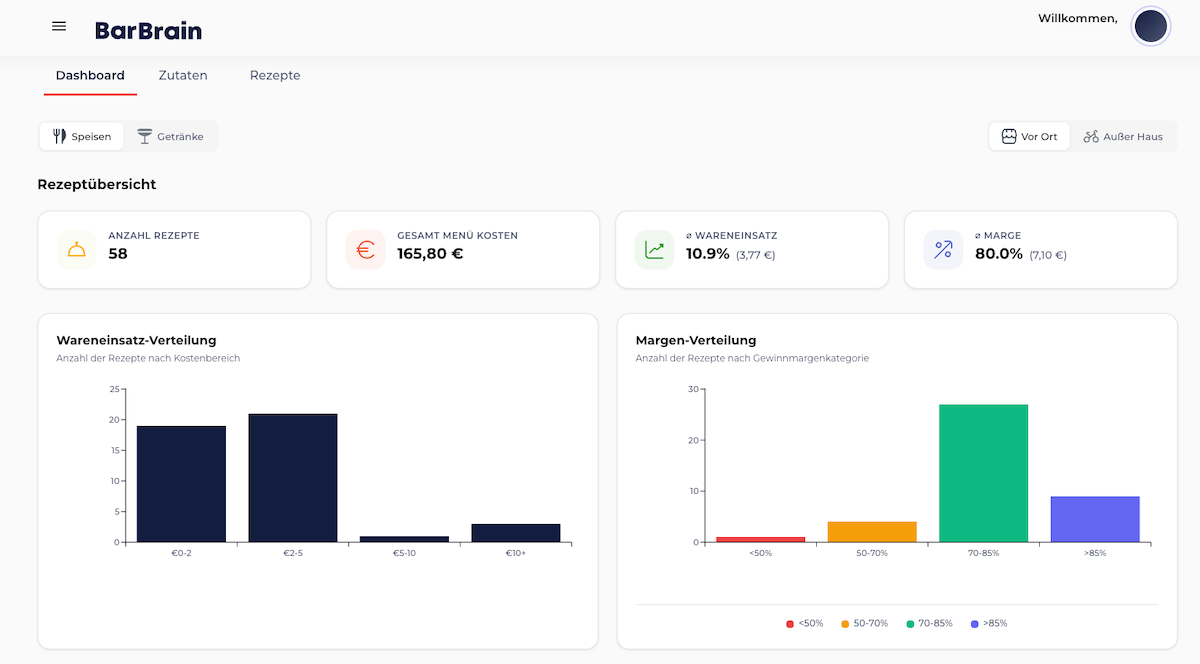
Analysing contribution margins: Professional costing does not stop at the price of an individual dish. A proven approach is the contribution margin calculation per item. For every dish you determine how much it contributes towards covering fixed costs and generating profit after deducting variable costs (cost of goods). This reveals which dishes and drinks make the largest contribution to the operating result – these best-sellers should be actively promoted. Conversely, you also identify slow sellers or products with a low contribution margin that need reviewing. Proceed systematically:
Determine cost of goods per item,
Calculate contribution margin (selling price minus cost of goods),
Rank and analyse dishes by their contribution,
Derive actions – e.g. adjust portion size, raise the price, or remove the item from the menu if it does not pay.
Such data-driven decisions significantly increase the overall profitability of your menu. Menu engineering is the keyword: the mix is what matters. Classics like a Wiener Schnitzel can afford to be more tightly priced (a 15–20 % profit mark-up is common here) if higher margins are achieved on other items. Many restaurants offset slim profits on some popular dishes through high profits on beverages or dessert sales – the important thing is that the bottom line works (blended calculation).
Common pricing mistakes: A widespread oversight is failing to reflect purchase-price increases in selling prices promptly. If, say, cheese or meat costs rise sharply, the costing quickly falls behind reality without a price adjustment – cost of goods shoots up and eats the margin. Therefore, review your costings regularly and adjust prices or recipes as soon as costs change. Do not be afraid to raise prices when costs increase – communicate openly why if needed, as guests understand that quality has its price. Another stumbling block is “forgotten” costs – for example, staff meals or complimentary extras for regulars. Such adjustments should be captured in the cost-of-goods calculation; otherwise they distort the figures. Shrinkage and spoilage (more on that shortly) also belong indirectly in the pricing: if a certain percentage of goods in your kitchen or bar typically goes unsold or is spilt, you should factor this into the calculation (either through slightly higher prices or through measures to reduce losses). Finally, market orientation is important: watch competitors’ prices and your guests’ willingness to pay. You should avoid a price war, but having a feel for market-appropriate pricing protects you from losing guests through excessive prices. The art lies in charging economically viable prices that cover your costs and generate profit without deterring guests.
Restaurant Inventory: Controlling Stock, Preventing Losses
Inventory – the regular counting, measuring and weighing of all stock – is seen by many as a tedious obligation. In fact, smaller hospitality businesses are often only legally required to do it once a year. But anyone who counts their cellar only once a year is flying blind the rest of the time. Experts recommend carrying out inventory at least monthly – not for the tax office, but for your own success. Why? Because stock worth five figures often sits in kitchens and cellars, and could shrink unnoticed without controls. Studies show that proper, regular inventory can save up to 20 % of cost of goods. Given a typical cost-of-goods share of ~30 % of revenue, that quickly makes the difference between profit and loss.
Inventory is your early-warning system. It shows what goods came into the storeroom, how much was consumed and what remains. If 10 kg of beef suddenly goes missing from the cold room without corresponding revenue, you have a problem – either spoilage, theft or serious costing errors. Without inventory you would not know where your money is going. Goods that should be missing but were never sold represent a direct loss of potential revenue. Regular stock counts uncover such sources of shrinkage: spoilage from incorrect storage, waste in the kitchen or unauthorised removal by staff. If stock is never checked, shrinkage and theft often go undetected – cost of goods creeps above the planned level.
Making weak points visible: An inventory compares the target stock per the books (what should be there based on purchases and sales) with the actual stock (what is really on the shelf). Discrepancies are booked as stock movements – for you they are tangible losses. Causes can include recording errors, theft or miscounting. Typical problem areas: the bar (keyword pouring loss), easily perishable goods in the cold room, or high-value products such as spirits and steaks where even small quantities translate into significant sums. At the bar, losses are almost a daily occurrence: beer foams over, a glass tips, shots are poured generously or given on the house. The tax office allows a flat rate of 3–5 % pouring loss – it should not really be more than that. But if nobody is watching, complimentary rounds and over-pouring can easily push shrinkage into double-digit percentages, which drastically reduces your beverage profits. Regular inventory (and possibly weekly partial counts for expensive spirits) creates transparency here. For instance, you can spot when two bottles of vodka “vanish” per week and respond accordingly.
Practical tips for inventory: Make the stock count a routine and part of your company culture. Set fixed intervals and responsibilities. For example, at Cosmo Burger inventory is carried out every week on the same day, before new goods are ordered – that is the most efficient approach. Work with structured checklists so no area is forgotten (think of the deep freezer in the cellar, the opened bottles at the bar, etc.). It is advisable to count in pairs: four eyes see more than two, and separating responsibilities (e.g. someone from the front of house counts the bar, someone from the kitchen counts the store) reduces the risk of manipulation or cover-ups. New deliveries on inventory day should be set aside and shelved only after counting, to avoid distorting the figures. During the count, also note anything conspicuous: expired goods, damage or overstocking.
Today, digitalisation can make life considerably easier: stock-management systems that link the till to stock levels exist. Every sale is automatically deducted from stock; when a minimum level is reached, the system reminds you to reorder. Such tools deliver reliable reports at the press of a button, highlighting savings potential. But even simple means – e.g. Excel lists – can achieve a lot, as long as you do it consistently. The crucial point is to analyse and act on inventory results rather than filing the list away unread. Ask yourself: does the goods consumption match expectations based on revenue and recipes? Where are the anomalies? Perhaps pouring loss is higher with a certain team member – a signal for training or tighter controls. Perhaps certain ingredients are regularly left over – a sign to adjust purchasing behaviour or revise the menu.
Ideally, inventory insights feed directly back into your business management. By spotting weaknesses early, you can intervene: improve purchasing processes, optimise storage (e.g. the FIFO principle – first in, first out – to minimise spoilage) or adjust recipes if it becomes apparent that too much is consistently being prepared. This reduces waste and saves real money. In short: regular inventory gives you control over the entire goods cycle – from purchasing through storage to sales. The result is lower cost of goods, a more orderly stockroom and the reassuring feeling that “nothing slips through the net”.
How Recipe Compliance, Cost of Goods, Contribution Margins and Stock Variances Interact
Having examined the three areas individually, the question arises: how do recipe management, pricing and inventory mesh? The answer: like cogs in a clockwork – only when all run in sync does the system work efficiently. In hospitality, cost of goods as a metric connects these areas like a common thread. It shows how much money you actually spend on goods to produce food and drinks. It therefore reflects both how consistently the kitchen calculates and works, and how well your pricing strategy functions and how severe losses in storage are.
Recipe compliance has a direct effect on cost of goods: if work is done cleanly to recipe, cost of goods per portion stays within the planned range. Contribution margins per dish then match expectations and your pre-calculation holds. If, however, recipes are disregarded, cost of goods per unit rises (e.g. through excess ingredient use) – the consequence is lower contribution margins and, in aggregate, a higher cost-of-goods ratio. This is reflected at the latest during inventory in the form of stock variances: the quantity consumed is greater than sales figures would suggest, so stock is missing. A practical example: suppose your kitchen team does not strictly follow the 150 g pasta portion per the recipe and generously plates 170 g. That is 20 g “too much” per portion. Sell 200 pasta dishes a month and 4 kg of pasta disappear over plan. Your recipe costing was based on 150 g – so cost of goods for this dish is around 13 % higher than assumed. The contribution margin per portion shrinks accordingly, and in the monthly inventory you have 4 kg less pasta in stock than the calculation suggests – a classic stock variance caused by poor recipe compliance.
Pricing and inventory also interact: correct pricing first of all requires correct cost-of-goods values (determined through recipe management). At the same time, a regularly calculated cost-of-goods ratio helps keep your prices realistic. If inventory shows that cost of goods is, say, 33 % of revenue, you can check whether your prices still hold – perhaps you need to adjust to get back to, say, 30 % and hit your target margin. Conversely: if your cost-of-goods ratio stays consistently in the green zone, that is an indicator that purchasing, recipes and selling prices are in balance.
Ideally, this triad becomes a continuous improvement process: the kitchen delivers reliable cost data thanks to recipe compliance, controlling (or you as the owner) sets market-appropriate prices on that basis, and inventory verifies whether theory and practice match. If something deviates – e.g. cost of goods or stock losses rise – you can intervene specifically: is it due to higher purchase prices? Then adjust prices or find cheaper suppliers. Is it due to excessive shrinkage? Then optimise processes, raise awareness among staff or tighten controls. Anyone who has their cost of goods under control steers their restaurant deliberately and with commercial success. This metric is not a dry number but a living management instrument that connects purchasing, kitchen and sales.
The point is clear: all three building blocks interlock. Neglect one and the structure wobbles – even optimal prices are useless if goods are “cooked away” in the kitchen; the strictest recipe compliance helps little if prices are incorrectly calculated; and careful costings remain theory if, due to missing inventory, more was consumed than assumed. Only the combination of recipe management plus costing plus inventory produces a coherent system that minimises losses and secures the profit margin.
Best Practices and Action Tips for Hospitality
How can all of this be put into practice in day-to-day operations? To close, here are some clear recommendations you can apply immediately:
Introduce standardised recipes: Document the exact ingredients and quantities for every dish. Train your team on recipe compliance – everyone must understand that 10 g extra truffle or an imprecise pour of spirit affects the operating result. Use measuring tools (scales, dosers) and make recipes easily accessible (recipe folder or digital tool).
Calculate cost of goods per dish: Take the time to determine the true cost for every menu item and every drink. Calculate cost of goods factoring in losses (trimmings, evaporation, tasting portions). This also reveals outliers – dishes that are unexpectedly expensive to produce.
Set prices with a plan: Never set selling prices on a whim. Choose a calculation method (e.g. mark-up factor or contribution margin calculation) and apply it consistently. Define target cost-of-goods ratios (e.g. “max. 30 %”). Example: if a cocktail costs €2 in ingredients, you should charge, depending on your concept, perhaps €8 to €12 to cover losses from pouring waste and operating costs. Many successful bars calculate drink prices with fixed mark-ups (e.g. factor 5 for spirits) – orient yourself by industry benchmarks but account for your own cost structure.
Recalculate regularly: Review your costings at fixed intervals (e.g. quarterly) or whenever significant changes occur. If supplier prices or new levies (carbon tax, VAT changes) rise, update your costing and adjust prices before the margin suffers. Do not be afraid to raise prices when costs increase – communicate openly why if needed, as guests understand that quality has its price.
Carry out monthly inventory: Run an inventory in your restaurant ideally every month (more frequently for high-turnover items). Schedule it at a quiet time (e.g. Sunday after closing or Monday morning before the delivery). Work systematically with checklists and count in pairs using the four-eyes principle. Record all stock – from the large cold room to the smallest liqueur bottle at the bar.
Analyse stock variances: After every inventory, compare target with actual stock. Investigate discrepancies: why, for example, are 3 bottles of wine missing? Were they forgotten in the booking (training issue), stolen (security issue) or lost to shrinkage (quality or storage problem)? Only by knowing the causes of shrinkage can you take corrective action – be it through stricter controls, better staff instructions or technical aids (e.g. pour-control systems that enforce a till entry before dispensing).
Involve and train staff: Make it clear to your team why these measures matter. Every chef who follows the recipe, every server who avoids a billing error, contributes to success. Convey that less waste also means more scope for investment, staff bonuses or job security. When everyone pulls together – kitchen, front of house, bar – you can extract the optimum.
Use digital tools: Consider investing in software for recipe management and stock control. Digital tools take much of the arithmetic off your hands, automatically update costings when prices change, and can reconcile sales with stock levels. This makes monitoring far easier and saves time – time you can then spend on your guests.
Conclusion: Systematic Work Leads to Sustainable Hospitality Success
A successful hospitality concept needs more than warm hospitality and delicious food – above all it needs economic substance. The three pillars presented – recipe management, correct pricing and regular inventory – form the foundation on which a profitable hospitality business rests. It may feel unfamiliar at first to focus so meticulously on numbers, grams and percentages, yet the effort pays off: even small improvements in cost of goods or pricing can noticeably boost profitability. And it is often precisely these “basics” that make the difference. Anyone who has their costs under control and knows their own metrics can navigate calmly even in turbulent times – whether through market price swings or rising operating costs.
At the end of the day, your hospitality business should not only make your guests happy but also secure a good livelihood for you as the owner. With clear recipes, fairly calculated prices and meticulous stock control, you create transparency and control. The connections between kitchen, costing and stockroom become comprehensible and manageable. You turn the right dials before losses occur. The motto is: “maintain control before it gets expensive.” Stick to these principles and your tables will not only be full – the till will add up at the end of the month too. Commercial success in hospitality is no accident; it is the result of consistent work on your own processes. So get started: calculate your cost of goods, work through your pricing and count your stock – your business will thank you with black figures!

Book your demo now!
Want to improve your inventory? Then it’s time to book a free demo.