Menu Engineering: Boosting Profit Through Strategic Menu Optimisation
Menu engineering increases hospitality profits through targeted menu design. Methods, examples and step-by-step guide for restaurants and bars.
Imagine your restaurant is well-filled every evening and guests are satisfied – yet at the end of the month barely any profit remains. Many operators know this dilemma: fundamental business principles are often neglected, above all a strategically optimised menu. The menu is far more than just a list of dishes; it is a decisive profit lever. Studies show, for example, that guests spend an average of just two to three minutes looking at the menu before deciding. In that short time they choose certain dishes – and that determines how profitable the visit is for your establishment. The menu should therefore never be left to chance. Through targeted menu engineering, profitability can be noticeably increased – well-executed menu optimisation can deliver an ongoing 10–15% more profit. In this article you will learn what menu engineering means, why it matters so much and how you can turn your own menu into a profit driver.
What is menu engineering?
Menu engineering is a data-driven method for designing and pricing a restaurant menu so that it generates maximum profit. It analyses sales figures (dish popularity) and contribution margins (dish profitability) to make informed decisions about menu design. Put simply, the aim is to actively promote popular and profitable dishes and to consistently remove or rework weak items. The foundation for this is sound recipe management. Every item on the menu should either be a revenue driver, deliver a solid margin – ideally both – or serve an important conceptual purpose. Otherwise, a dish has no long-term place on your menu and should be replaced by more profitable alternatives. Menu engineering is not a one-off project but a continuous process: menus should be reviewed and adjusted regularly to adapt to changing costs and guest preferences. The right mix of analysis and creativity ensures your menu both delights guests and optimises profit.
Why menu engineering matters so much
The menu is one of the most important tools a hospitality business has for managing revenue and profit. Targeted menu engineering maximises profitability without compromising the guest experience – in fact, it often improves it. Many businesses, however, do not exploit this potential. Experts estimate that around 60% of restaurants carry out no systematic menu optimisation and as a result easily achievable profits are left on the table. Those who allow their menu to grow unchecked or set prices and dishes “by gut feeling” risk hidden loss-makers and missed revenue opportunities. A well-considered menu, by contrast, can significantly increase profit per guest without simply raising all prices.
Specifically, menu engineering offers a number of tangible benefits. First, overall profit can be increased by identifying profitable dishes and featuring them more prominently. Second, menu analysis leads to better cost control: you spot dishes with high food costs and low margins and can adjust prices or recipes. Unprofitable items ideally disappear from the menu, which immediately raises your average margin. Third, an optimised offering contributes to reducing food waste. By streamlining the selection and using similar ingredients across multiple dishes, you plan your purchasing more efficiently and have to throw away less surplus. Fourth, a well-balanced menu improves the guest experience: you offer guests attractive, sought-after dishes in a clear format. Decision-making becomes easier; the guest feels guided rather than overwhelmed by endless options. Finally, regularly reworking the menu fosters innovation. You stay flexible, can try out new trends or seasonal products and continuously refine your offering. Overall, the menu becomes a powerful management tool for your business – one that links guest satisfaction with operational efficiency.
Keeping cost of goods in check: precise calculation as the foundation
The first step in menu engineering is basic but essential: know the exact cost of every single dish. A solid calculation of all recipes forms the foundation for every subsequent decision. Nevertheless, a large share of hospitality businesses reportedly forgo a complete recipe calculation – surveys suggest around 80% of restaurants do not fully cost their dishes. The reasons are understandable: it seems time-consuming to record every ingredient down to the gram plus all accompaniments, dips and garnishes for every dish. Yet without this data you are flying blind financially. If ingredient costs are not fully accounted for, some dishes are unknowingly sold below cost. Likewise, the classic rule of thumb “cost of goods × 3 = selling price” often misleads, because it ignores overheads, labour and fluctuations in purchase prices. Pricing by gut feeling is dangerous: some dishes may have a far-too-low margin, whilst others may appear overpriced and deter guests. Precise calculation of each recipe, on the other hand, reveals the true cost of goods per portion and the contribution margin (selling price minus costs) for every menu item.
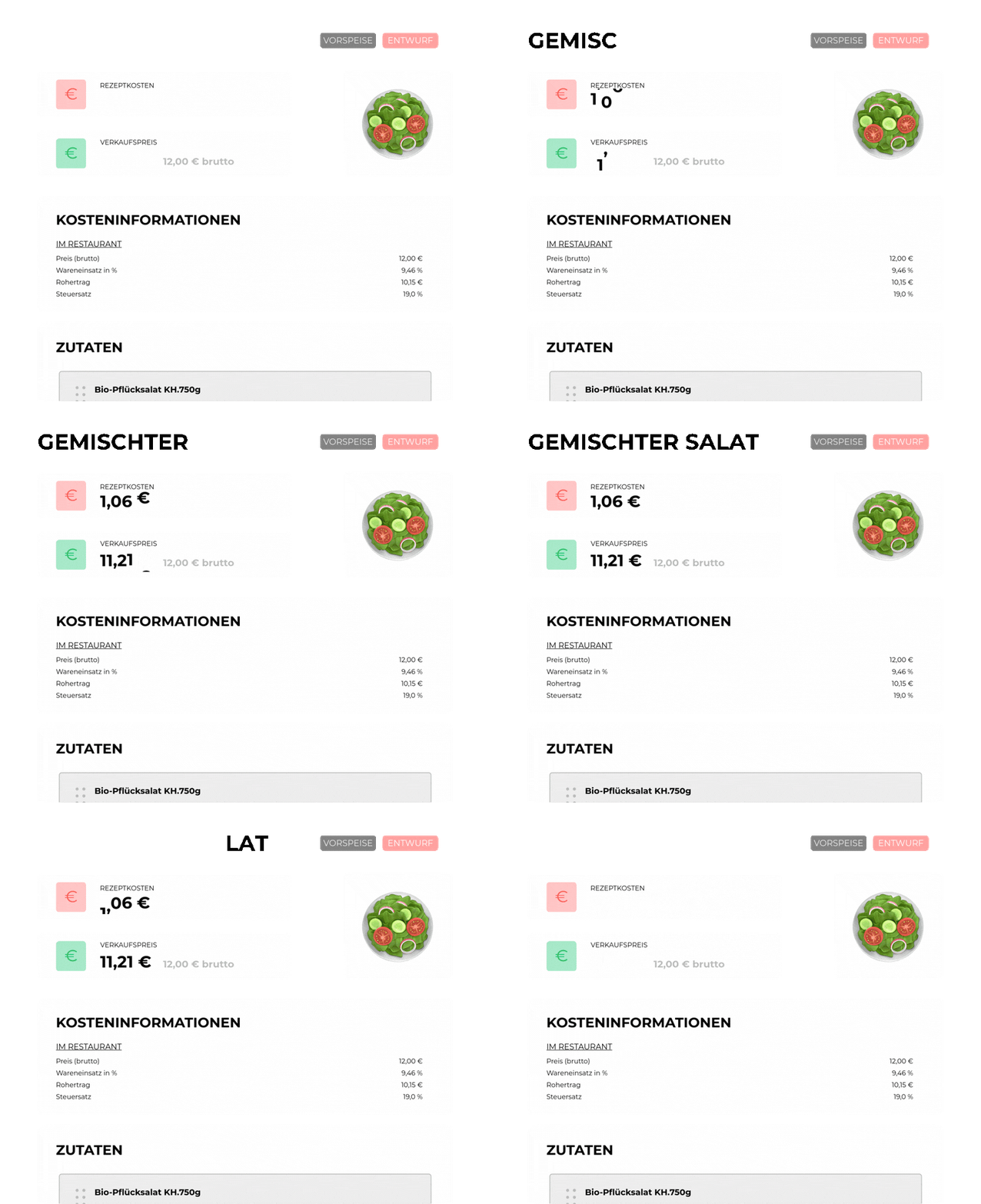
Carry out this calculation consistently for all dishes and update it regularly. The prices of many ingredients are subject to seasonal fluctuations – if purchase costs rise, your margin shrinks unless you adjust. Only those who know the current costs can react in time. In practice it is therefore advisable to use technological support. Modern recipe management software – such as the BarBrain recipe management tool – takes over much of this work. It allows you to record all ingredients and quantities centrally; the cost of goods per portion is calculated automatically and instantly updated when prices change. This means you always know which dishes are profitable and which are not. Fluctuations also become transparent: if a dish’s profitability suddenly drops below your target value, you can take immediate action. In short: exact recipe calculation is the foundation for successful menu engineering. Invest the necessary time or use digital tools to keep this data under control – it pays off.
Analysing sales data: which dishes are the bestsellers?
Besides costs, you need to understand which dishes are popular with your guests and which are slow movers. As the next step, therefore, analyse sales figures over a representative period (e.g. several months). Modern POS systems and digital restaurant analytics make it straightforward to obtain accurate sales statistics: every ticket reveals how often a dish was sold, and you should absolutely use this data. Look at which menu items are ordered most frequently – these are your stars or bestsellers. Equally important is a glance at the other end: which dishes are hardly ever ordered? This list of “slow movers” often holds surprises, because the sales hits do not always match your subjective expectations.
In addition to the hard numbers, it is worth incorporating feedback from service staff and guests. Your employees usually know very well which dishes are regularly praised and which are sent back more often. Guest comments (direct or on review platforms) can also provide clues as to why certain dishes find more or less favour. It is important to put sales data in context: seasonal effects or special promotions can temporarily influence popularity. If your cold dishes sell more in summer than in winter, that is to be expected – such seasonal trends should be taken into account. Nonetheless, the analysis quickly produces a picture of which dishes are indispensable and which are up for review. These findings are now combined with the costing results.
Analysing and optimising dishes: stars, workhorses, puzzles & dogs
Once you have determined both the profitability (costing) and the popularity (sales ranking) of your dishes, you can divide your menu into four groups – a classic menu-engineering outcome. Each category requires a different strategy:
- Stars – dishes that are both popular and profitable. These are your top performers and should remain on the menu unchanged. Make sure you have sufficient capacity to meet demand, and highlight these top dishes prominently – for example with a label on the menu or as the dish of the day. Stars are the centrepiece of your business and deserve maximum attention.
- Workhorses – dishes that are frequently ordered but only marginally profitable (high demand, low margin). These items generate turnover but contribute little to profit. Fine-tuning is needed here: check whether a moderate price adjustment is feasible, or whether you can reduce costs – for instance through slightly smaller portions or less expensive ingredients – without noticeably affecting quality. Even a small increase in the selling price, communicated skilfully, can have a major impact on monthly profit for a high-volume dish. Take care, however, not to jeopardise the workhorse’s appeal; these dishes are often crowd favourites you do not want to lose. You may also want to consult our blog on contribution margin calculation.
- Puzzles – dishes with a high margin but low order frequency. These dishes have great profit potential in theory but are not (yet) catching on with guests. Ask yourself what the reason might be. Is the dish hard to find or inconspicuously placed on the menu? Does the name or description perhaps not sound enticing enough? It may simply lack visibility. Active promotion and clever placement can help here: present such dishes, for example, as a Chef’s Special or in a highlighted box on the menu to draw attention. Train your service staff to actively recommend these high-margin dishes. A rework of the recipe or the name may also be worthwhile to increase appeal. The aim is to turn the “puzzle” into a star. Should a dish continue to underperform despite all efforts, consider replacing it with a better-suited option.
- Dogs – dishes that are neither frequently ordered nor profitable (slow movers with a low margin). Such items have no real place on an efficient menu. Do not hesitate to remove genuine loss-makers from the offering. Every slot on the menu occupied by a “dog” is missing for a potentially more successful creation. Some operators find it hard to drop dishes – perhaps because a dish was part of the original concept or has a small loyal following. But bear in mind: if a menu item is barely ordered and, on the rare occasions it is, generates little to no profit, it ties up resources (storage space, ingredients, preparation time) and dilutes the overall performance of your menu. Free yourself of ballast. A leaner menu with high-performing dishes often looks more appealing and also simplifies kitchen and service workflows.
After categorising your dishes, develop concrete measures. Actively promote the stars and winners: these dishes should be front and centre in your menu design, as noted above. Optimise the workhorses carefully to extract more. Push the potential puzzles through marketing or specials so they receive more attention. And declutter the dogs without false sentimentality. This process is dynamic – continuously monitor the impact of your changes. Perhaps an adjusted dish suddenly becomes a star, or a formerly popular item loses traction and slips in favour. Menu engineering is never “finished” but an ongoing cycle of analysis, adjustment and monitoring. Use test runs too: temporary promotions or changing daily specials are ideal for trialling new dishes and gauging guest feedback before adding them permanently to the range. This keeps you flexible and allows you to refine your offering steadily without overwhelming your guests.
Designing a menu that sells (psychology & design)
Beyond the content selection of dishes, the design of the menu itself plays a major role in sales success. Studies in hospitality psychology show that layout, wording and price presentation noticeably influence guest ordering behaviour. Therefore, ensure your optimised selection is also presented optimally:
Clarity and structure: Make sure the menu is clearly organised and easy to read. Standard categories (starters, mains, desserts, drinks) give the guest orientation. Avoid excessively long lists – focus on your best offering. As a rule of thumb, around 7 dishes per category is considered ideal – enough choice without overcrowding. When in doubt, remove further “mid-range” dishes rather than including every conceivable variation. A compact, focused menu signals professionalism and eases the decision.
Highlighting: Use visual accents to direct guests’ attention deliberately. For example, particularly profitable dishes or current recommendations can be emphasised through graphic elements – such as a framed chef’s recommendation or an icon. Placement also matters: studies have shown that the most eye-catching zones on a physical menu are at the top or centre of a page. Position your stars and high-margin items preferably in these spots where the guest’s eye falls first. Less profitable or secondary dishes can be placed less prominently. In this way you subtly steer your guests’ choices towards the desired items.
Price presentation: The way prices are displayed on the menu unconsciously influences price perception. Many successful concepts omit the currency symbol (“€”) next to prices, since the symbol reminds the subconscious of spending – without the symbol, the figure feels less “monetary”. Similarly, “charm prices” have proved effective: if a price ends in 90 or 99, customers often perceive it as cheaper (“psychological price threshold”), whilst round amounts (e.g. €10.00) tend to be perceived as premium and expensive. Such details can make the difference between a guest choosing a dish or opting for a cheaper alternative instead. It is also important not to foreground the price list too aggressively. Avoid, for example, arranging dishes strictly from cheapest to most expensive, as this draws undue attention to price. Let the guest decide by taste and interest instead, not by scanning for the cheapest option at first glance.
Conclusion: your menu as a success factor
In today’s hospitality industry, with rising costs and fierce competition, no business can afford to treat its menu merely as decoration or a necessary evil. Menu engineering is one of the most effective – and often underestimated – ways to increase profitability without compromising the guest experience. Through data-driven analysis of your dishes and conscious menu design, you extract the optimum from every visit. Naturally, this process initially requires effort and discipline: recipes need to be maintained, prices calculated and sales data evaluated. But this effort pays off directly in hard cash. Many restaurants have been able to significantly increase their profits through menu optimisation, sometimes within a short period. Equally important: a consistently managed menu enables you to react quickly to changes – whether fluctuating food prices, new dietary trends or guest feedback. Instead of adding or removing dishes haphazardly, you have a clear compass for decisions. As an experienced head chef once put it: “Every dish on the menu must prove itself – or it has no business being there.”
Use menu engineering as an ongoing improvement process. Review the performance of your menu at least seasonally (if not more often) and do not shy away from making adjustments. Remember that accurate data is the foundation of every optimisation – so maintain your costings and sales statistics diligently. The good news: you do not have to do this alone. Digital tools can take over much of the work. For example, the BarBrain recipe management tool enables you to keep all recipes and cost factors in view and see at a glance which dishes are profitable. Such solutions help integrate menu engineering efficiently into daily operations so you can focus on execution and creativity.
In summary: your menu significantly determines your profit. A well-thought-out menu engineering approach boosts not only profitability but also guest satisfaction – a true win-win. Especially from independent restaurants to small chains, this can make the difference between good food and good business. Do not leave this success to chance. Start now, analyse and optimise your menu step by step. Your bottom line will thank you – and so will your guests.

Book your demo now!
Want to improve your inventory? Then it’s time to book a free demo.