Food Cost Formula: How to Calculate Your Cost of Goods Correctly
Calculate your food cost correctly: the right formula, benchmarks for bars and restaurants, and 7 levers to lower it. Free Excel template inside.
If you want to run a profitable hospitality business, you need to keep your food costs under control. Yet many operations do not know exactly how high their actual cost of goods is – let alone how to reduce it systematically. In this guide you will learn everything about the food cost formula, how to calculate it, which benchmarks apply to your type of business and which strategies help you cut costs immediately.
1. What is food cost?
Food cost (German: Wareneinsatz) refers to the total cost of all food and beverages a hospitality business uses to prepare its dishes. This includes raw ingredients, spices, oils, sauces and every other ingredient that ends up on the plate or in the glass. Food cost is one of the most important metrics in hospitality because it directly influences how profitably a business operates. Even small deviations of a few percentage points can mean thousands of euros in profit or loss over a year. The crucial point: food cost is consumption, not purchasing. Purchasing is merely inflow. Consumption arises from “opening stock + deliveries – closing stock”. Without a proper inventory at the start and end of each period, any ratio is just an estimate.
Food cost is not the same as the purchase price. It also encompasses shrinkage, spoilage, incorrect portioning and theft – i.e. the actual costs incurred until a dish reaches the guest.
Why food cost matters so much
In a typical restaurant, 28 to 35 per cent of revenue goes on cost of goods. Together with labour costs (25–35%), food costs form the largest cost block. If you do not pay close attention here, you quickly lose control of your margin.
2. The food cost formula in detail
There are several variants of the food cost formula, depending on whether you want to calculate the cost of goods for a single dish, a period or as a percentage of revenue.
2.1 Basic formula: food cost per dish
Food cost per dish = sum of all ingredient costs
Add the cost of each individual ingredient in the exact portion quantity.
Example: a pasta dish with ingredients costing €3.20 has a food cost of exactly €3.20. Sounds simple – but it becomes complex when you have 50+ dishes on the menu and must calculate every ingredient down to the correct portion size.
2.2 Food cost percentage formula
Food cost % = (cost of goods ÷ revenue) × 100
The most important KPI: what share of your revenue goes on ingredients?
This formula is the industry gold standard. If your restaurant generates €80,000 in revenue in a month and spends €26,000 on food, your food cost percentage is 32.5%.
2.3 Food cost formula for a period
Period food cost = opening stock + purchases – closing stock
Calculate your actual consumption over a defined time frame.
This formula takes your stock into account and shows what was actually consumed in a given period – regardless of when you made the purchases.
📊 Practical example: Opening stock: €8,000 | Purchases in the month: €22,000 | Closing stock: €6,500 → Actual consumption = 8,000 + 22,000 – 6,500 = €23,500. At €75,000 revenue, this gives a food cost percentage of 31.3%.
3. Food cost percentage – the most important metric
The food cost percentage is the proportion of your revenue spent on cost of goods. It is the central KPI for any hospitality controlling and the basis for your pricing.
What does the food cost percentage tell you?
- Below 28%: Very good – you are working with a strong margin or have a premium concept
- 28–32%: Good – industry average for full-service restaurants
- 32–38%: Acceptable – typical for businesses with a high raw-material share (e.g. steakhouse, sushi)
- Above 38%: Critical – urgent action is needed
Important: the food cost percentage alone does not tell you whether your business is profitable. A dish with 40% food cost that you sell for €45 yields €27 in gross profit – significantly more than a 25% dish sold for €12 with only €9 gross profit. You should therefore always keep an eye on the absolute contribution margin too. Here is a blog on this topic.
4. Calculating food cost: step by step
Here is how to calculate your food cost systematically – whether for a single dish or your entire operation:
Step 1: Determine recipe costs
List all ingredients of a dish and calculate the cost per portion. Use the actual purchase price (not the list price) and the exact quantity that goes into one portion.
Step 2: Determine the selling price
Take the net selling price of your dish (excluding VAT), as only this amount is available to cover your costs.
Step 3: Calculate the food cost percentage
Divide the recipe cost by the net selling price and multiply by 100. Example: ingredient cost €4.80 ÷ net SP €15.00 × 100 = 32% food cost.
Step 4: Target-vs-actual comparison
Compare your calculated (target) food cost with the actual consumption from the period formula. The difference reveals losses from shrinkage, incorrect portioning or theft.
Important: Do not forget the hidden costs: spices, oils, garnishes, sides and sauces are frequently left out of the calculation, yet they often account for 3–5% of food costs.
5. Food cost calculator – how to use it
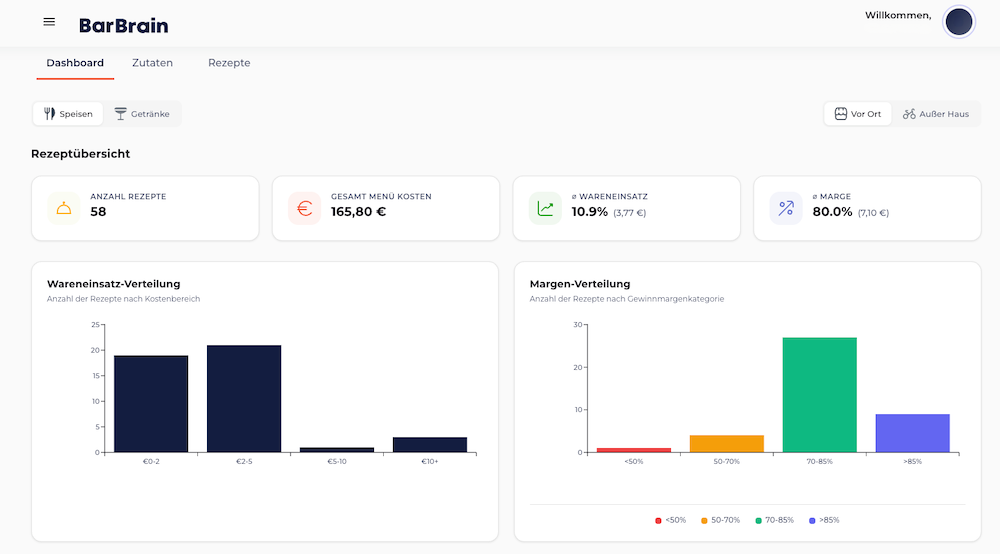
A food cost calculator takes the manual arithmetic off your hands. You enter ingredient costs and selling price and immediately get your food cost percentage. Professional tools go further and automatically calculate the recommended selling price based on your target food cost.
What a good food cost calculator should offer
- Recipe costing: Automatic calculation of ingredient costs per portion
- Price suggestion: Recommended selling price based on your target food cost percentage
- Scenario analysis: What happens to your margin if ingredient prices rise by 10%?
- Batch calculation: Costing for the entire menu at a glance
6. Ideal food cost percentage by restaurant type
There is no universal ideal food cost value. The benchmark depends heavily on your business type, concept and location. The following table provides guidance:
| Restaurant type | Ideal food cost % | Explanation |
|---|---|---|
| Fast Food / QSR | 25–30% | High throughput, inexpensive ingredients, standardisation |
| Casual Dining | 28–32% | Industry average, mid-range pricing |
| Fine Dining | 30–35% | Premium ingredients, offset by higher selling prices |
| Steakhouse / Seafood | 35–40% | Expensive core products, margin via sides & beverages |
| Pizzeria / Pasta | 24–28% | Inexpensive base ingredients (flour, dough, tomato sauce) |
| Café / Bakery | 25–30% | High margins on coffee, lower on baked goods |
| Cloud Kitchen / Ghost Kitchen | 26–32% | No dining area, but factor in delivery costs |
| Bar / Cocktail Bar | 18–24% | Beverages generally have lower food costs |
The ideal food cost percentage is not automatically the lowest. What matters is the contribution margin per dish and your overall concept. A fine-dining restaurant with 33% food cost can be significantly more profitable than a fast-food outlet at 27%.
7. Strategies to reduce your food costs
You now know your numbers. Here are seven proven strategies to sustainably lower your food cost:
Strategy 1: Precise recipe costing
Create an exact recipe card for every dish on your menu, with gram quantities and current purchase prices. Without this foundation, any further optimisation is guesswork. Update the costing at least monthly.
Strategy 2: Portion control
Use scales, portioning spoons and standardised containers. A deviation of just 20 g per portion of salmon (approx. €0.60) adds up to over €900 per month at 50 portions per day.
Strategy 3: Supplier negotiation & price comparison
Regularly compare prices between at least two to three suppliers. Negotiate volume discounts on large items and check for seasonal alternatives. Even a 5% saving on purchasing feeds directly into your margin.
Strategy 4: Menu engineering
Analyse your menu for stars and dogs (as described in our blog). Push high-margin dishes through better placement on the menu and remove low performers with high food costs and low demand.
Strategy 5: Reduce shrinkage and spoilage
Implement a strict FIFO system (First In, First Out). Monitor refrigeration and storage temperatures daily. Use cross-utilisation: leftovers from the lunch menu become the evening’s soup or daily special.
Strategy 6: Regular inventory
Carry out inventory weekly or at least twice a month. Only then can you compare your actual consumption with the target consumption and spot variances early.
Strategy 7: Use digital tools
Modern food cost software automates costing, stock management and ordering. You see in real time where your costs stand, receive alerts for price fluctuations and save hours of manual work each week.
Quick win: Start with strategies 1 and 6: cost your recipes and carry out regular inventories. These two measures alone reduce food cost by 2–4 percentage points in most businesses.
8. Food cost control: methods for everyday use
Food cost control means not just calculating your cost of goods once, but continuously monitoring and managing it. Here are the key methods:
Target-vs-actual analysis
Compare your theoretical food cost (based on recipe cards and sales figures) with actual consumption each month. The difference – often called “variance” – shows you where money is being lost.
Daily food cost tracking
Record purchases and revenue daily to calculate your running food cost. This way you spot problems immediately, not at the month-end when it is too late to take action.
Waste tracking
Keep a waste log. Note what is thrown away, why and in what quantity. Common causes are overproduction, incorrect storage and expired goods. The data helps you take targeted countermeasures.
Supplier price monitoring
Track the price development of your top 20 ingredients (which typically account for 80% of your purchasing costs). React proactively to price increases through portion adjustments, menu changes or supplier switches.
9. Frequently asked questions (FAQ)
What is a good food cost percentage?
For most full-service restaurants the ideal food cost percentage lies between 28 and 32 per cent. Fast-food concepts often achieve 25 to 28 per cent, whilst steakhouses and seafood restaurants can accept up to 40 per cent.
How do I calculate food cost per portion?
Add the costs of all ingredients in the exact quantity needed for one portion. Example: 150 g salmon at €22/kg = €3.30 + 200 g vegetables at €3/kg = €0.60 + sauces and sides €0.90 = €4.80 food cost per portion.
What is the difference between food cost and Wareneinsatz?
Essentially the same: “food cost” is the internationally used English term, “Wareneinsatz” the German equivalent. Both refer to the cost of food and beverages in relation to revenue.
How often should I calculate my food cost?
Ideally weekly as a running food cost. A full calculation with inventory is recommended at least twice a month. This way you spot trends early and can take timely action.
How do I reduce my food cost quickly?
The fastest levers are portion control (immediate effect), supplier comparison (short-term) and menu engineering (medium-term). Start with precise recipe costing – most businesses discover that their actual portion sizes are significantly above the calculation.
What is included in food cost?
All food and beverages used for production, including spices, oils, garnishes, take-away packaging and losses from shrinkage or spoilage. Not included are labour costs, rent, energy and other operating costs.
Should I calculate food cost per dish or across the entire menu?
Both. The per-dish calculation is the foundation for your pricing. The overall food cost across all dishes shows you whether your mix is profitable as a whole. This is also referred to as “blended food cost”.
Conclusion: your food costs under control
The food cost formula is no mystery – but applying it consistently is what separates profitable hospitality businesses from struggling ones. Start by costing your recipes cleanly, carry out regular inventories and use the benchmarks in this guide to put your figures in context. And when you are ready to take the next step: a digital inventory management solution automates costing, stock management and ordering – saving you hours of manual work every week.
.jpeg)
Book your demo now!
Want to improve your inventory? Then it’s time to book a free demo.