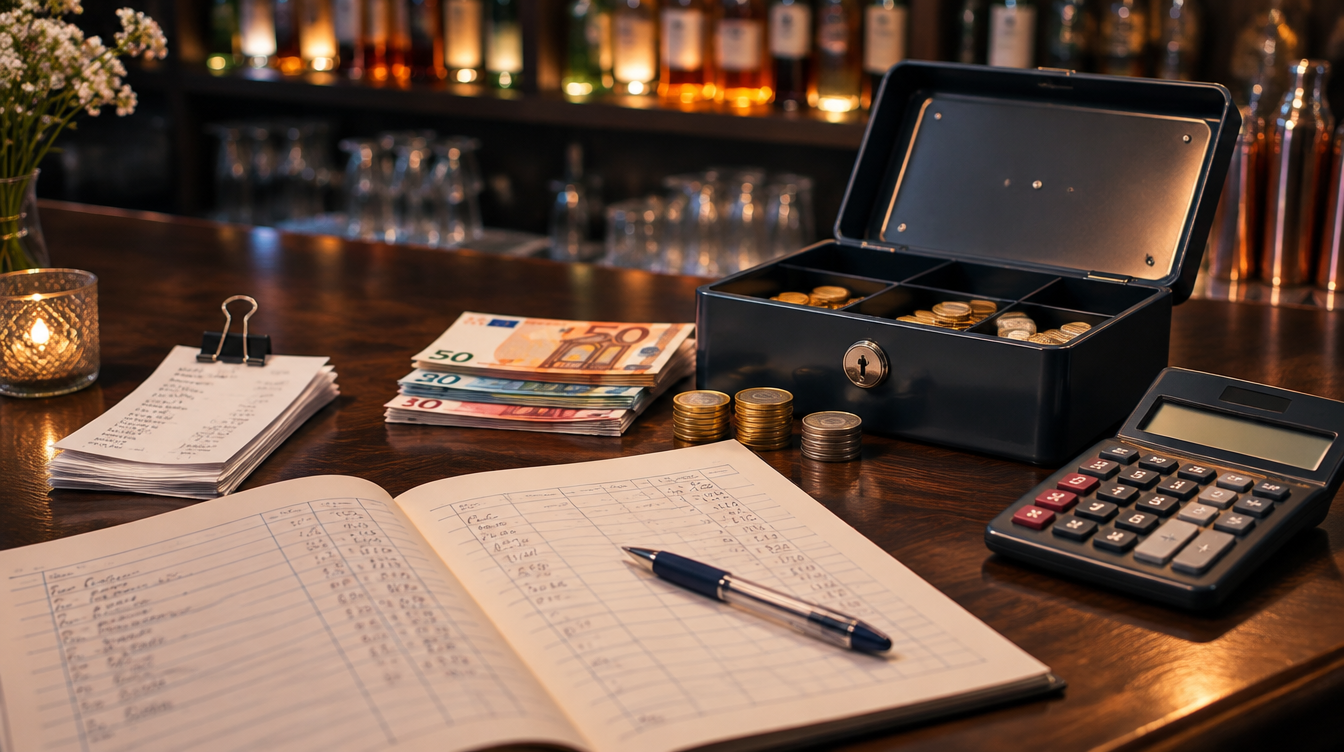
Friday night, the shift is over, and there is €1,120.40 in the till. How much of that did you actually take today? At lunchtime you paid €86.40 in cash for lemons and ice at the cash-and-carry, in the afternoon you took €1,500 to the bank, and in the morning there was €300 in change in the drawer. If you run an open cash drawer in Germany, you have to document exactly this calculation every day. Our cash book template for hospitality makes it a matter of minutes: cash book, daily cash report and cash count sheet as a printable PDF. In this guide you will learn who needs a cash book, how to fill in the template and which mistakes become expensive in a cash audit.
1. Who needs a cash book in hospitality?
There is no obligation to use a cash register in Germany. If you work without an electronic POS system, i.e. with an open cash drawer such as a cash box or drawer, you still have to record your cash takings completely. This applies, for example, to small bars, snack bars, kiosks, food trucks, club houses or pop-up stands.
According to the Munich Chamber of Commerce (IHK München), businesses required to keep accounts must keep a cash book for their cash movements, if necessary in the form of consecutive cash reports. In principle, the individual recording obligation under Section 146 (1) of the German Fiscal Code (AO) applies: every sale is recorded individually. Under Section 146 (1) sentence 3 AO, there is an exception only if goods are sold exclusively for cash to a large number of unknown persons. In that case, you may determine daily takings with a daily cash report. The information sheet of the Bremen tax office lists cases in which this usually does not apply: if you also accept card payments, some customers are known (for example through invoices or an order book) or other rules require individual records.
Important: with an open cash drawer, a cash book alone does not replace the daily cash report, as the Bremen tax office expressly points out. That is why our template contains both. If you use an electronic POS system with a TSE (technical security device), the individual records come from the system. Whether and how you also keep a cash book is best clarified with your tax adviser.
2. What goes into a cash book?
A cash book documents every movement in your till in chronological order. Sheet 1 of the template has the following columns:
- No. and date: a consecutive number per entry and the day of the booking.
- Receipt no.: reference to the matching receipt, for example the cash report, a purchase receipt or a self-issued voucher.
- Description: a short note such as “Daily takings 14 Nov”, “Cash-and-carry purchase” or “Bank deposit”.
- Income and expense in €: the amount in the matching column.
- VAT rate and VAT amount in €: rate and tax amount, if you or your tax adviser record them here.
- Cash balance in €: the new balance after every row.
At the top you enter the business, month, sheet number and the balance carried forward from the previous sheet; at the bottom the totals, closing balance and signature. This way every sheet connects seamlessly to the next.
3. Daily cash report: how to work back to the daily takings
With an open cash drawer, you determine the day’s takings backwards, which is why this report is also called a retrograde cash report. In the evening you count all the cash, add everything that was taken out of the till during the day and subtract everything that did not come from sales. What remains is your daily takings.
With the figures from the beginning, it looks like this:
You enter the €2,456.80 as daily takings in the cash book. The Bremen tax office stresses that you may neither round nor estimate. According to the information sheet, a cash count sheet is not mandatory but is recommended to strengthen its evidential value. Sheet 2 of the template therefore has a cash count sheet with all notes and coins directly below the cash report.
4. Six rules for a proper cash book
- Record daily and individually: According to IHK München, cash income and expenses must be recorded daily, as must every private withdrawal and deposit.
- No entry without a receipt: Every expense needs a receipt or invoice. For private withdrawals, deposits and cash taken to the bank, you write a self-issued voucher.
- Balance never negative: According to IHK München, the cash balance can never be negative, because a till cannot be emptier than empty. A minus is a clear warning sign in any audit.
- Handwritten instead of Excel: According to the Bremen tax office, a cash report created with standard software such as Excel is not protected against subsequent changes and does not meet Section 146 (4) AO. Electronic solutions are only permitted if the software meets the GoBD (German principles for proper electronic bookkeeping).
- Keep corrections visible: Cross out incorrect entries so that they remain legible and correct them next to it. No correction fluid, no erasing, no pencil.
- Stay ready for a cash count: The balance in the cash book must match the actual cash at all times. Auditors can count the cash unannounced.
The comparison shows that most problems are not caused by wrong figures but by a lack of traceability. You can find more on the legal basics in our guide to proper cash management in hospitality and to the daily cash closing.
5. How long do you have to keep the cash book and receipts?
According to IHK Stuttgart, the retention period for books and records is ten years. For accounting vouchers, a shorter period of eight years has applied since 1 January 2025. The period starts at the end of the calendar year in which the last entry was made. Which period applies to your cash reports is best agreed with your tax adviser. If in doubt, keep the cash book and cash reports for ten years.
6. Keeping an eye on cash purchases: cash book and inventory
Many expenses in the cash book are purchases of goods: lemons from the cash-and-carry, a crate of tonic water from the drinks wholesaler, ice for the terrace. The cash book only shows the amount. For your cost of goods, however, you need to know which items went into stock and in what quantity. Otherwise these quantities are missing at the next stocktake or show up as shrinkage. Private use of goods also needs to be documented; more on this in our guide to staff and owner consumption in hospitality.
With the BarBrain delivery note and invoice scanner, you simply take a photo of the cash-and-carry receipt. The AI detects the items and books the goods receipt into your inventory. The receipt itself stays with the cash book, and the quantities end up in your stock. This keeps till and storage in line, and your stocktake shows what is really there.
7. Frequently asked questions
Is a cash book in Excel allowed?
What is the difference between a cash book and a cash report?
Do I need a cash book if I use a cash register?
Is a cash count sheet mandatory?
How do I record a bank deposit in the cash book?
Does BarBrain help with cash management?
Note: This guide and the template provide a general overview and do not replace advice from a tax adviser. As of November 2026.

About the author
Max Möbius
Senior Operations Manager