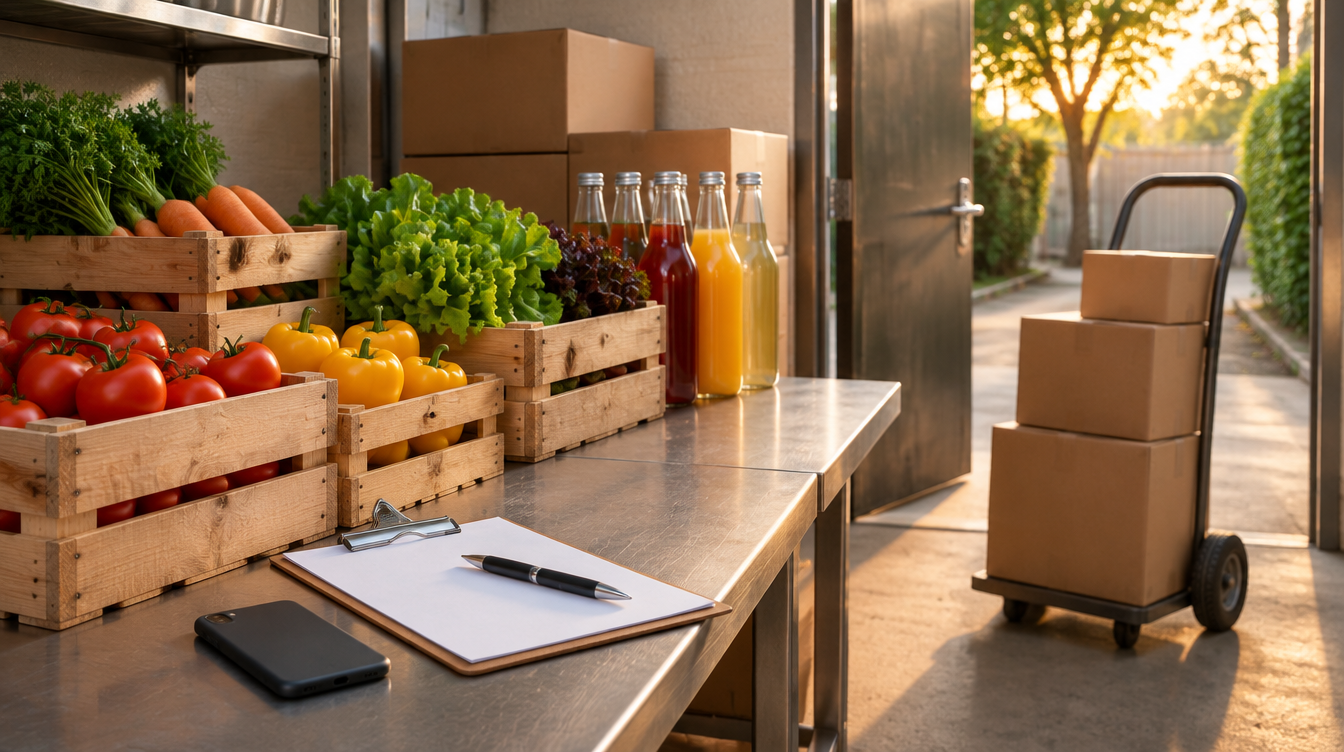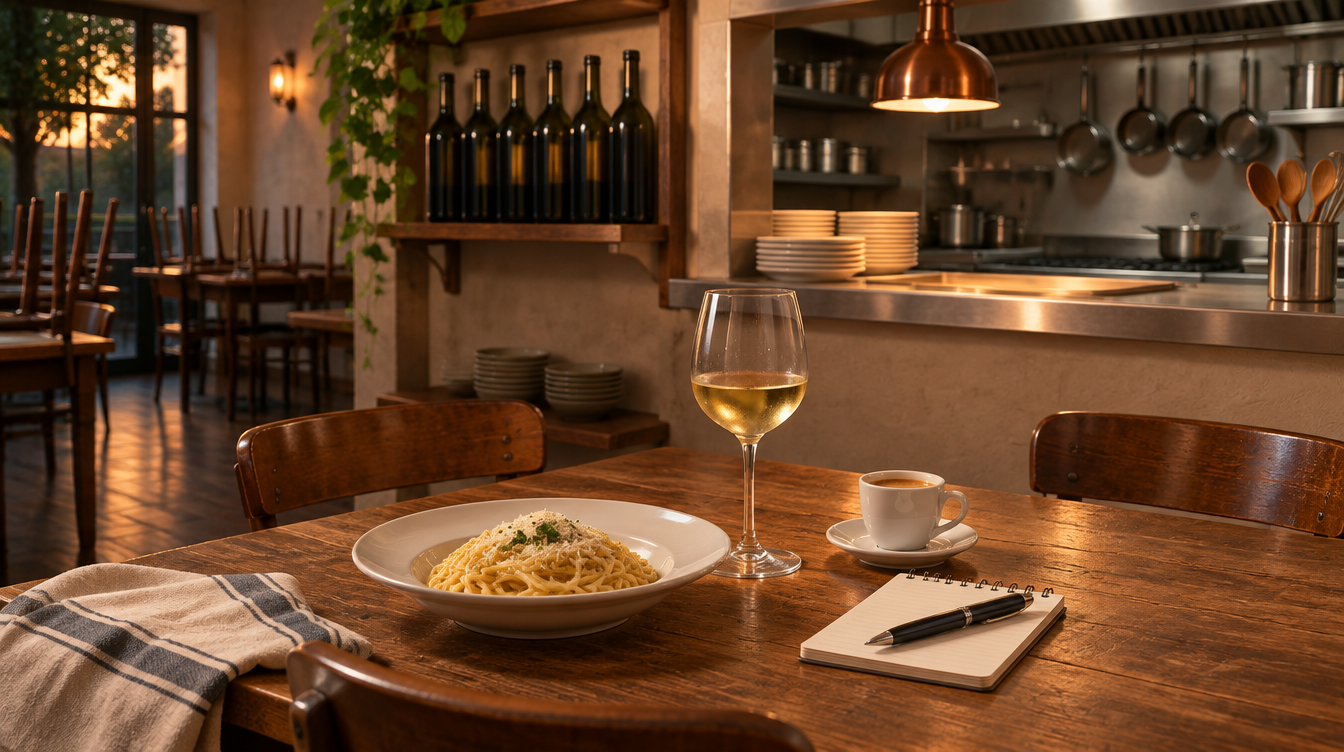
An espresso before the shift, dinner with the family in your own restaurant, a bottle of wine for Sunday at home: for restaurant and bar owners, that is everyday life. For tax purposes, it is owner's own consumption in hospitality (in German: Eigenverbrauch), and you have to account for it even though no receipt is ever printed. At the same time, the goods disappear from your stock. If they are not recorded anywhere, they show up as shrinkage at your next stocktake.
In this guide you will learn which flat rates apply to restaurants in Germany in 2026, how to calculate own consumption including VAT, and how to organise it so that your stocktake and your target-vs-actual comparison stay clean.
1. What is owner's own consumption in hospitality?
Own consumption is the everyday term for what German tax law calls a free supply of goods, often also referred to as a withdrawal of goods. It means goods that you, as the owner, take from the business for private purposes: food, drinks and other groceries that you consume yourself or take home. Because you bought these goods as a business expense, the withdrawal has to increase your profit again and is treated like a sale for VAT purposes.
It is important to distinguish it from other stock movements that are often lumped together in practice:
- Own consumption: private withdrawals by you as the business owner, usually including the people in your household.
- Staff consumption: food and drinks for employees. This is not own consumption but a payroll matter: meals are usually valued as a benefit in kind.
- Complimentary items: the shot on the house or a tasting portion for regulars.
- Breakage and spoilage: broken bottles, expired goods, spilled drinks.
All four have one thing in common: the goods leave your stock without a normal sale in the POS. How to document breakage and spoilage is covered in our guide to shrinkage and breakage in hospitality. This article focuses on own consumption and how it affects your figures.
2. 2026 flat rates: owner's own consumption in hospitality at a glance
So that you do not have to record every single withdrawal, the German Federal Ministry of Finance publishes flat rates per type of business every year. The values for 2026 come from the BMF letter of 23 December 2025 (Hamburg Chamber of Commerce, ZDH, both in German). They apply per person and year and are net values excluding VAT:
- Restaurants of all kinds serving cold food: 1,824 € reduced rate + 629 € standard rate = 2,453 €
- Restaurants of all kinds serving cold and hot food: 3,173 € reduced rate + 828 € standard rate = 4,001 €
- Café and patisserie: 1,610 € reduced rate + 598 € standard rate = 2,208 €
"Reduced rate" is the share subject to 7% VAT, "standard rate" the share subject to 19%. The shift compared with 2025 is striking: back then, the value for restaurants serving hot food was 2,292 € at the reduced rate and 1,753 € at the standard rate, 4,045 € in total (steuerschroeder.de, in German). The total has stayed almost the same, but a much larger share now falls under the reduced rate. According to the ZDH, this reflects the reduction of VAT on restaurant and catering services to 7% from 1 January 2026, excluding drinks. What else the change means for your business is explained in our guide to VAT in hospitality 2026.
3. The key rules for the flat rates
The flat rates are a simplification: if you use them, you do not have to record individual withdrawals (section 148 sentence 1 of the German Fiscal Code, see Haufe, in German). In return, fixed rules apply:
- Annual value per person: the amount applies to one person and a full calendar year.
- Children: no flat rate applies up to a child's second birthday; up to the twelfth birthday, half the amount applies.
- No additions or deductions: personal eating habits, holidays or illness do not change the value (steuertipps.de).
- Tobacco: tobacco products are not included in the flat rates; you account for their withdrawal separately.
- Mixed businesses: if several business types overlap, only the higher flat rate applies (Hamburg Chamber of Commerce).
Whether the flat rate suits you or whether special rules apply in your case, for example with several owners, a limited company as operator or an opening during the year, is something to discuss with your tax adviser.
4. Calculating own consumption: a worked example
Take a restaurant with a hot kitchen run by a couple who own it together. Both regularly supply themselves from the business, and there are no children. This is how you calculate it:
- Reduced-rate share: 2 × 3,173 € = 6,346 €
- Standard-rate share: 2 × 828 € = 1,656 €
- Own consumption, net: 6,346 € + 1,656 € = 8,002 € per year
- VAT: 6,346 € × 7% = 444.22 € and 1,656 € × 19% = 314.64 €, together 758.86 €
- Own consumption, gross: 8,002 € + 758.86 € = 8,760.86 €
You can also book the value in monthly instalments. At 8,002 € net, that is 8,002 € ÷ 12 = around 666.83 € per month. If the couple had an eight-year-old child, half the flat rate would be added, i.e. 2,000.50 € net, 10,002.50 € in total.
The figures show why own consumption is not a side issue: it noticeably increases your profit and your VAT liability, even though no money goes into the till. If it is forgotten, it is missing from the books. In a tax audit in hospitality, own consumption is therefore one of the points you should be able to document properly.
5. Booking own consumption in practice
In your accounts, own consumption is recorded as a free supply of goods, split into the share at 7% and the share at 19% VAT. Which accounts are used depends on your chart of accounts, your method of profit calculation and your accounting software. The flat rates can also be booked monthly (steuerschroeder.de), which makes your monthly figures more realistic than a single booking at year-end.
As an operator, three things matter most:
- Decide once at the start of the year how many people are included and which flat rate applies.
- Pass this information to your tax adviser so the values are included in every monthly report.
- Check for changes, for example when a child crosses an age threshold or another owner joins.
6. Separating own consumption, staff meals and complimentary items
For tax purposes, own consumption and staff consumption are two different topics. Meals for employees are valued as a benefit in kind through payroll. For 2026, the values are 2.37 € for breakfast and 4.57 € for lunch or dinner per calendar day (Techniker Krankenkasse, in German). How drinks for your team are treated for payroll tax is something to clarify with your tax adviser. Complimentary items for guests are yet another topic that you classify together with your tax adviser.
For your stock, however, the tax classification makes no difference. The bottle of white wine the owner takes home is missing from the shelf just like the after-shift drink of a server or the gin for a regular. What matters is whether the movement is documented anywhere. This is exactly where many businesses have a blind spot.
7. Why own consumption shows up as shrinkage in your stocktake
The flat rate is a euro amount for your accounts. It does not remove anything from your stock. When, after a stocktake, you compare your target usage, i.e. POS sales times recipe quantity, with your actual usage, the withdrawn goods are missing. They appear as a variance and, without further information, cannot be told apart from over-pouring, breakage or theft. How this calculation works in detail is explained in our guide to target-vs-actual comparison in hospitality.
An example: over the course of a month, the owner takes four bottles of white wine home, the team drinks mineral water at the end of their shifts, and half a kilo of beans goes into the owners' espressos. None of it is rung up at the POS. After the stocktake, the comparison shows:
- White wine: 4 bottles × 6.50 € = 26.00 €
- Espresso beans: 0.5 kg × 18.00 € = 9.00 €
- Mineral water: 6 bottles × 0.60 € = 3.60 €
Together that is a variance of 38.60 € at purchase price that looks like shrinkage in your report, even though the cause is harmless.
The problem is not the amount in a single month but the lack of clarity. When harmless withdrawals and real losses sit in the same variance, you can no longer tackle shrinkage in a targeted way. You look in the wrong place or get used to a variance that should actually be a warning sign. More on typical causes can be found in our article on stocktake variances in hospitality.
8. How to separate own consumption cleanly from shrinkage
The solution is simple and works in any business: everything that leaves your stock is recorded somewhere. Proceed in four steps:
- Record: set up dedicated POS keys or a separate server number for owner withdrawals and staff drinks. That way these movements are included in target usage. This booking records quantities for your stock; it is not additional revenue on top of the flat rate. How to set up the bookings correctly for tax purposes is something to agree with your tax adviser.
- Count: complete the stocktake per area, i.e. bar, kitchen, storeroom or wine cellar. Only with a closing stock can actual usage be calculated.
- Compare: compare target and actual per item. Because withdrawals are now included in the target, only the variances you cannot explain remain.
- Investigate: check the remaining variances in a targeted way, starting with the most expensive items.
A clear rule in the team also helps: no drink without a booking, not even for the boss. That sounds strict, but it protects everyone involved, because variances can then be clearly attributed. The figures from the POS keys also serve as a plausibility check for the flat rate: you can see the order of magnitude of the actual withdrawals.
9. Own consumption and target-vs-actual comparison with BarBrain
With the BarBrain POS integration, sales from your POS, your recipes and your stocktake come together in one place. BarBrain calculates target usage from them, compares it with actual usage from opening stock, goods received and closing stock, and shows you the variance per item in quantity and euros. Staff drinks and complimentary items that you ring up separately at the POS are included in target usage instead of the variance. You then investigate the causes with your team.
The foundation for this is your recipes in recipe management, the digital stocktake with stock per area, and complete goods receipt via the AI delivery note scanner. If you run several outlets, each outlet is its own account with its own areas. In the admin overview you compare locations, for example on cost of goods ratio and shrinkage.
That way you see every month which variances can be explained and where a closer look is worthwhile, without evaluating tally sheets or merging spreadsheets.
Want to see what this looks like in your business? Book a demo: in 30 minutes we will show you the target-vs-actual comparison with your processes.
10. Frequently asked questions
How high is the owner's own consumption for restaurants in 2026?
Does the flat rate apply per person or per business?
Can I claim less for holidays or illness?
Are staff meals also owner's own consumption?
How do I stop own consumption from distorting my shrinkage rate?
Do the flat rates also apply in Austria and Switzerland?
About the author
Johanna Jakobsson
BarBrain Team