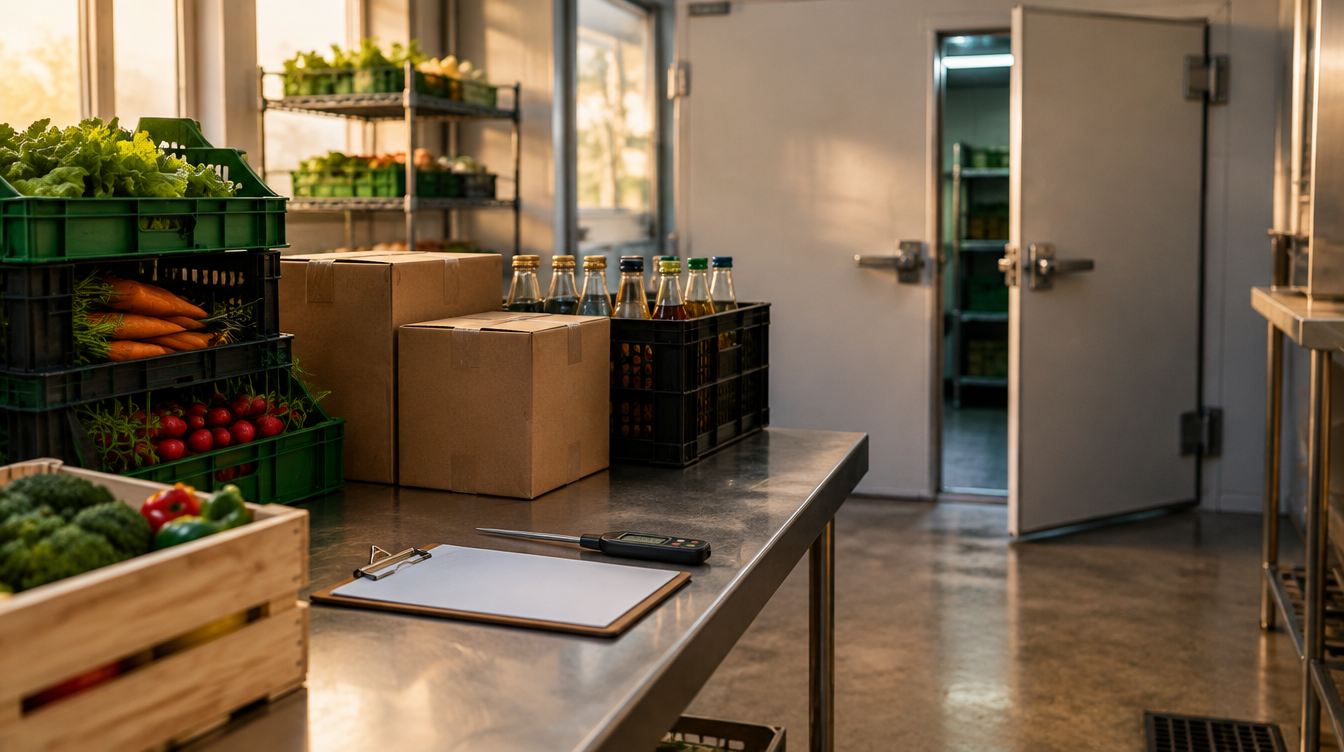
The supplier is at the door at 7:30 am, the kitchen is preparing for lunch service, and someone quickly signs the delivery note. Only days later does anyone notice that a crate was missing or the salmon arrived too warm. This is exactly where goods receipt inspection comes in: it is the short, fixed check between delivery and storage that protects you from short deliveries, quality problems and wrong figures.
In this article you will learn what goods receipt inspection in hospitality involves, which legal deadlines apply, which temperatures you should check for chilled goods and how to organise the process so that your team actually follows it day to day. At the end you will find a checklist to take away.
1. What is goods receipt inspection?
Goods receipt inspection is the check of every delivery at the moment it is accepted. You compare whether what is on the delivery note has actually arrived – in the right quantity, in perfect condition and, for food, at the right temperature. Only then do the goods go into the storeroom, the cold room or behind the bar.
In hospitality, the inspection does three jobs at once: it safeguards the quality of your food, it protects your money because you only pay for what was actually delivered, and it provides the figures for your inventory management. Every goods receipt feeds into your cost of goods: opening stock plus goods received minus closing stock gives your actual consumption. If a delivery is missing from your records or recorded incorrectly, this calculation no longer adds up. How the big picture fits together is explained in our article Inventory management in hospitality.
2. The goods receipt inspection process in 4 steps
A good inspection has to be quick, otherwise it gets skipped when things get busy. A fixed four-step process has proven effective:
Step 1 – Receive: Put the delivery note and the goods side by side. Check that supplier, date and delivery address are correct and that the delivery matches your order.
Step 2 – Check: Count or weigh the items and check packaging, best-before dates and, for chilled and frozen goods, the temperature.
Step 3 – Document: Record discrepancies immediately, ideally directly on the delivery note and countersigned by the driver. Raise a complaint with the supplier on the same day.
Step 4 – Book: Add the quantity actually accepted to your stock. Only then is the goods receipt complete.
Also decide who is allowed to accept deliveries. If only trained team members sign, the risk of a delivery note being signed unchecked goes down. Schedule deliveries outside peak times where possible, so that there are a few minutes left for the inspection.
3. What exactly you check during goods receipt inspection
Quantity and items
Do the items, pack sizes and quantities match the delivery note? Typical errors are missing crates, wrong pack sizes (0.7 l instead of 1.0 l) or substitute items delivered without agreement. For meat, fish and vegetables it pays to re-weigh, because these are invoiced by weight.
Condition and packaging
Damaged boxes, torn vacuum packs, broken bottles or partially thawed frozen goods should be rejected straight away. Once goods have been accepted and put away, they are hard to return later. You can read more about losses from breakage in our article Shrinkage and breakage in hospitality.
Temperature of chilled and frozen goods
For perishable food you measure the product temperature with a probe thermometer. The goods receipt fact sheet of the City of Cologne (in German) gives, for example, the following maximum values:
- Fresh meat (beef, pork, lamb): no more than 7 °C
- Fresh poultry and minced meat products: no more than 4 °C
- Offal: no more than 3 °C
- Frozen goods: −18 °C or colder (−15 °C for short periods)
Fresh fish should be delivered on ice. According to the fact sheet, the measured temperature is recorded and confirmed with a signature; in case of defects such as elevated temperature, you record the action taken, for example returning the goods. The requirements of your local food inspectorate and the manufacturer’s instructions always take precedence – Austria and Switzerland have their own rules set by the authorities.
Best-before dates and labelling
Check best-before and use-by dates. Goods that only keep for a few more days often do not fit your consumption and otherwise end up in the bin. Also make sure the goods are labelled so you can clearly assign them in storage.
Prices on delivery note and invoice
Many venues check quantities but not prices. Yet this is exactly where price increases creep in. If the bottle of gin suddenly costs more, your cost of goods per drink changes – without anyone noticing. So regularly compare delivery note or invoice prices with your agreed prices.
4. Legal side: know your duty to inspect and give notice
Besides food safety, goods receipt inspection also has a commercial law side. Under Section 377 of the German Commercial Code (HGB), where a purchase is a commercial transaction for both parties, the buyer must inspect the goods without undue delay after delivery, as far as this is feasible in the ordinary course of business, and notify any defect without undue delay. If the buyer fails to give notice, the goods are deemed accepted – unless the defect could not be detected during the inspection. If such a hidden defect appears later, notice must be given without undue delay after it is discovered.
For you this means: if you only complain days later, you risk losing your claims against the supplier. Inspection at the point of delivery is therefore not just good practice – it protects your money.
Austria and Switzerland: In Austria, Section 377 of the Austrian Business Code (UGB) requires defects to be notified within a reasonable period. In Switzerland, under Art. 201 of the Swiss Code of Obligations (OR), the buyer must inspect the goods as soon as is feasible in the ordinary course of business and notify defects immediately. For individual cases, it is best to clarify the details with your legal adviser.
5. Worked example: what skipping the inspection costs
An example from the day-to-day of a bar with a kitchen. On Monday morning two deliveries arrive and the delivery notes are signed without checking:
- A crate of tonic water with 24 bottles at €0.55 net each is missing: 24 × €0.55 = €13.20
- Instead of 3 kg of salmon fillet only 2 kg are delivered, but 3 kg at €24.00 net are invoiced: 1 kg × €24.00 = €24.00
Together that is €37.20 on a single day. If this happens once a week, it adds up to 52 × €37.20 = €1,934.40 a year – money you can hardly recover without goods receipt inspection, because the deadline for complaints has long passed. There is a second effect, too: in your stocktake the missing goods then show up as shrinkage, and your cost-of-goods percentage rises without you finding the cause. How to count stock properly is shown in our stocktake guide for hospitality.
6. Goods receipt inspection checklist
You can give these points to your team as a checklist:
- Delivery note present, supplier and date correct
- Delivery matches the order
- Items, pack sizes and quantities correct (re-weigh fresh goods)
- Packaging undamaged, no breakage
- Temperature of chilled and frozen goods measured and recorded
- Best-before and use-by dates checked
- Prices compared with agreed terms
- Discrepancies noted on the delivery note and countersigned by the driver
- Complaint sent to the supplier on the same day
- Goods put away correctly straight away and booked as goods receipt
Put the list up where deliveries arrive. A properly calculated minimum stock level also helps you order only what you really need.
7. Goods receipt inspection with BarBrain
The most time-consuming part of goods receipt inspection is often not the check at the door but recording everything afterwards: delivery notes pile up, get typed up at the end of the month, and until then stock and cost of goods are inaccurate. With BarBrain’s AI delivery note scanner, this step becomes part of accepting the delivery.
This is how it works: you photograph the delivery note with your smartphone when the goods arrive, or upload a delivery note or invoice as a PDF. The AI reads line items, quantities, pack sizes and purchase prices. Supplier item names that differ from yours are matched to your own items, and for a substitute item BarBrain asks you to confirm whether it is the right one. You check the recognised line items and book the whole delivery as goods receipt with one click. Your stock is then up to date immediately.
You see price changes directly in the review list, and the new prices flow into your items and into recipe management. Together with digital stocktaking, this gives you a complete calculation of opening stock, goods received and closing stock – the basis for the target vs. actual comparison via the POS integration.
The difference in everyday work: without software, delivery notes are typed up at the end of the month, supplier names are translated by hand and price changes are often noticed only later. With BarBrain you capture the delivery by photo or PDF, items are matched, price changes appear in the review list and stock is up to date immediately after booking. For hotels and groups: each outlet is its own account with its own areas, and in the admin overview you compare outlets with each other.
Want to see what this looks like for your venue? In a no-obligation demo we show you the delivery note scanner in action. Book a demo now.
8. Frequently asked questions
What does goods receipt inspection in hospitality involve?
How quickly do I have to report defects in a delivery?
What temperatures apply when accepting chilled goods?
Do I have to document goods receipt inspection?
How does BarBrain help with goods receipt inspection?

About the author
Max Möbius
Senior Operations Manager